
Sensing Peat
← ProjectsSensing Peat journeys into the watery, wounded, and wondrous worlds of peatlands. Bringing together artists, scientists, activists, and local communities, the arts and research platform invites attunement to bogs, mires, and swamps as both a physical terrain and a space of deep cultural, ecological, and affective resonances. Peatlands, with their slow time and buried memory, become sites for listening, learning, and imagining otherwise — beyond extractivist logics and human exceptionalism. Sensing Peat creates opportunities for shared inquiry: into the stories held in wet soils, the shifting forms of mire-dwelling species, and the complex entanglements between climate, colonial histories, and land use. Sensing Peat embraces the bog as a being with agency – a collaborator, a teacher, an archive.
Sensing Peat is a transdisciplinary arts and research platform at the Michael Succow Foundation / Greifswald Mire Center, providing a crucial link between science, art and nature conservation. The ecofeminist, anti-colonial infrastructure co-initiates localised arts, community and research formats in and with different peatlands. Sensing Peat is a core artistic initiative and co-organiser with The Venice Agreement for Peatlands, a bottom up movement for transdisciplinary peatland conservation that centres local initiatives.

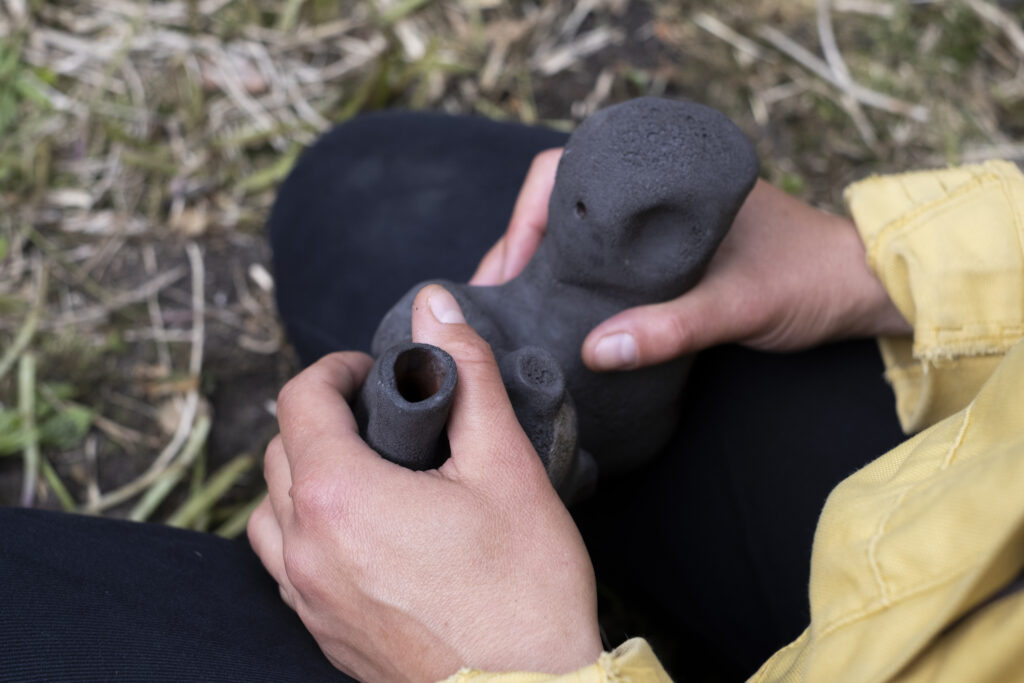
Turakella Editha Gyindo, Milulu, 2026
Sensing Peat Video Art Channel
As part of the main festival exhibition at GOUDasfalt May 30 – June 21.
What would it mean to see and sense the world through swamps, fens, bogs, and mires
in a time of strengthening social and ecological movements towards interdependent planetary re-existence
in a time of accelerating climate catastrophe and militarisation, ecocide and genocide?
What narratives of resistance, survival, and healing are inscribed in the landscape of the swamp?
And how are these fragile ecosystems still exposed to forms of ecocidal politics today? What forms of resistance exist, and who are their actors?
Through a constellation of five video works based in wounded and wondrous worlds of peatlands in East Africa, along the Baltic Coast, in Northern and Eastern Europe, Sensing Peat tunes into a wet (or to be rewetted) net that spans around planet earth that holds pasts and futures.
The works by Turakella Editha Gyindo, Jeanna Kolesova, Philipp Modersohn, Marina Naprushkina, and Juliane Tübke have been created between 2024 and 2026, or are in progress, in collaboration, conversation or proximity with Sensing Peat.
Milulu
Turakella Editha Gyindo
2:31 min, 2025
Lake Nyasa Wetlands, Tanzania
The Deaf Peatland
Marina Naprushkina
Research material, film excerpt: Melioration With Emotions and Without Emotions, Belvideocenter, 1990
11:43 min, 2026
Polesia Peatlands, Belarus
Undrainment
Philipp Modersohn
15:09 min, 2024
Ķemeri Purvs, Latvia; Sedas Purvs, Latvia; Nambigirwa Wetland, Uganda; Anklamer Stadtbruch, Breitenfeldermoor, Tollensetal, Quelkorner Moor and Spandauer Teufelsbruch, Germany; Aukštumalos Durpynai, Lithuania
Cuts
Juliane Tübke
2:22 min, 2024
Steinbecker Vorstadt Polder, Germany
Under the Peatland
Jeanna Kolesova
21:33 min, 2025
Haukkalampi, Finland; Kaigu, Baloži, and Seda purvs, Latvia; Esterweger Dose and Märchen See, Gemany; Meshchora peatlands, russia; multiple peatlands in European territory of former Soviet Union.
Dainėja [/dɑːˈneɪ.jɑː/]
Lecture Performance
Sunday June 7, 15.00
Muziektent Reghthuysplein
Nieuwkoop
As part of Tales from the Swamp
Facilitated by: Kim Bode (research associate, Bureau of Transitioning Landscapes) and Dr. Dr. Kallia Kefala (psychical researcher and paranatural environmental scholar)
What does it mean when a landscape begins to speak?
Kim Bode (Bureau of Transitioning Landscapes) and Dr. Dr. Kallia Kefala invite you to a lecture performance that moves into the unseen margins of the bog. Their work emerges from ongoing field practices in which listening, recording, and situated observation are used not to extract certainty, but to cultivate an understanding of unstable forms of perception. In this context, the bog begins to appear not as a passive environment, but as a site where acoustic and ecological traces accumulate over time in ways that exceed conventional scientific frameworks. What is encountered in the field does not resolve into stable data but persists as partial signals, interruptions, and residues.
Biographies:
Dr. Dr. Kallia Kefala holds dual doctorates in psychical research and paranatural environmental studies. Her work focuses on liminal spatial configurations and the entrancement triggered by spectral ecologies. She examines how supernatural presences interact with attention, behavior, and belief across unstable landscapes.
Kim Bode is a research associate at the Bureau of Transitioning Landscapes, which studies terrains not only as geographies but as metabolizing archives. Their work merges hydroacoustic sensing, landscape anthropology, and speculative ecology, tracing residual signals and disturbances across wetland systems and submerged zones.
Sensing Peat
Sensing Peat is a transdisciplinary arts and research platform at the Michael Succow Foundation for the Protection of Nature, partner in the Greifswald Mire Center. It was established in 2023 in collaboration with The Venice Agreement for Peatlands and with the ongoing support of the Andrea von Braun Foundation. Since spring 2024 Sensing Peat is curated by researcher and poet Suza Husse.
The Sensing Peat Video Channel was initiated on occasion of Green Heart Biennial, 2026. Works by Jeanna Kolesova, Juliane Tübke, Marina Naprushkina, Philipp Modersohn, Turakella Editha Gyindo. Concept and curation: Suza Husse.
Graphics: Rosario Ureta and Angelo Santa Cruz. Thanks to Eric Kluitenberg, Terrestris and Green Heart Biennial team.
The first iteration of the performance Dainėja [/dɑːˈneɪ.jɑː/] by Kim Bode and Dr. Dr. Kallia Kefala has been developed in the context of WETBEINGS Aukštumala ~ Arts, Science & Story Field Symposium (Sensing Peat & Foundation for Peatland Conservation and Restoration, Lithuania 2025).
Project website:
www.sensingpeat.net